Direct answer: Big Buddha Phuket is a monumental 45-metre seated Buddha on Nakkerd Hill in southern Phuket. Visitors come to see the enormous white marble landmark, pay respect at the religious complex and enjoy panoramic views towards Chalong Bay, Kata, Karon and the surrounding hills. It is a modern place of worship and reflection rather than an ancient Phuket temple.
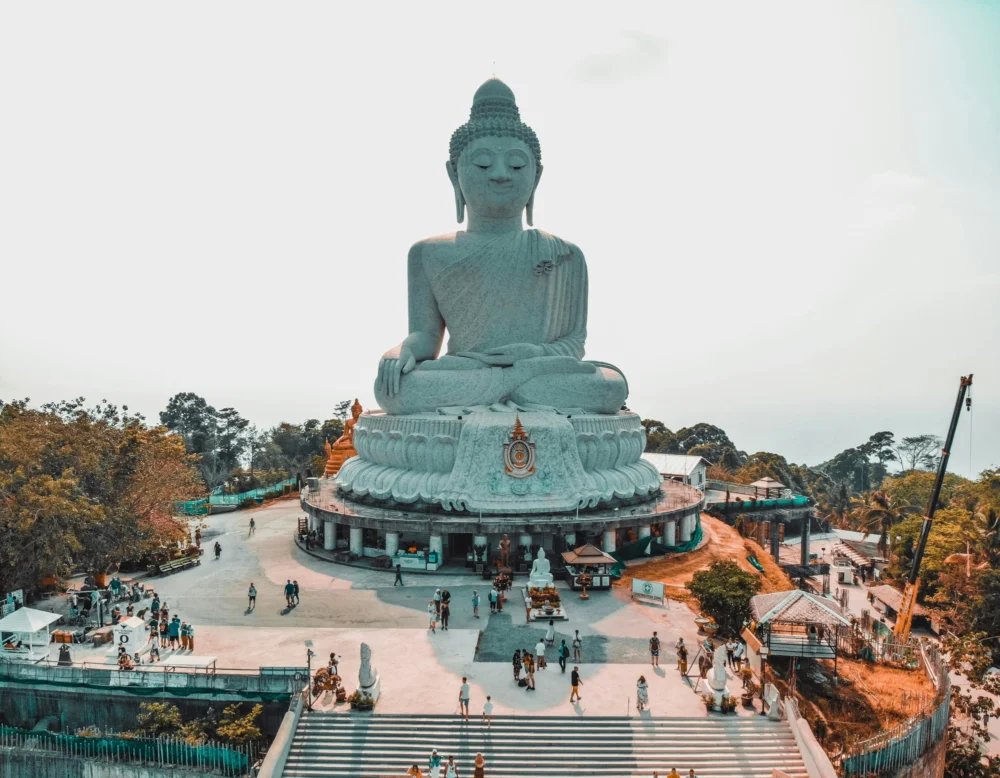
Rising above the green hills of southern Phuket, Big Buddha can be seen from many parts of Chalong, Kata and Karon. Its hilltop position and bright white exterior have made it one of the island’s most recognisable cultural landmarks.
However, Big Buddha should not be treated only as a photography stop. The site remains a Buddhist religious place where local residents come to pray, make merit and spend a quiet moment away from Phuket’s busier tourist areas.
Important Access Update for 2026
The Big Buddha site closed following the serious landslide near Nakkerd Hill on 23 August 2024. After safety reviews and a lengthy closure, local reporting states that the attraction reopened to visitors on 3 March 2026.
As of July 2026, reported visitor hours are approximately 9:00 a.m. to 6:00 p.m., with last entry around 5:30 p.m. Access conditions and opening hours may change, especially during periods of heavy rain. Visitors should check a current local notice before travelling up the hill.
Is Big Buddha Phuket a Temple?
Big Buddha is sometimes casually called “Big Buddha Temple,” but it is more accurately described as a modern Buddhist monument and religious complex built around a monumental Buddha image.
It does not have the centuries-old history of a traditional temple such as Wat Chalong. The main attraction is the giant Buddha, accompanied by smaller sacred images, prayer areas, bells, a gong, viewing terraces and spaces connected to the continuing development of the religious complex.
How Did Big Buddha Phuket Begin?
The Big Buddha project began in the early 2000s, with the foundation stone laid in 2002. The site developed gradually through donations from Thai Buddhists, local residents and visitors.
The statue received the official name Phra Phuttha Ming Mongkol Eknakiri and was recognised in 2008 as an important Buddhist image of Phuket. Construction continued for many years, with the main statue becoming complete while parts of the base and surrounding religious complex continued to develop.
Unlike Phuket’s historic temples, Big Buddha therefore tells a relatively modern story—one about a growing island community creating a shared symbol of faith, peace and identity.
What Makes the Main Buddha Such an Important Phuket Landmark?
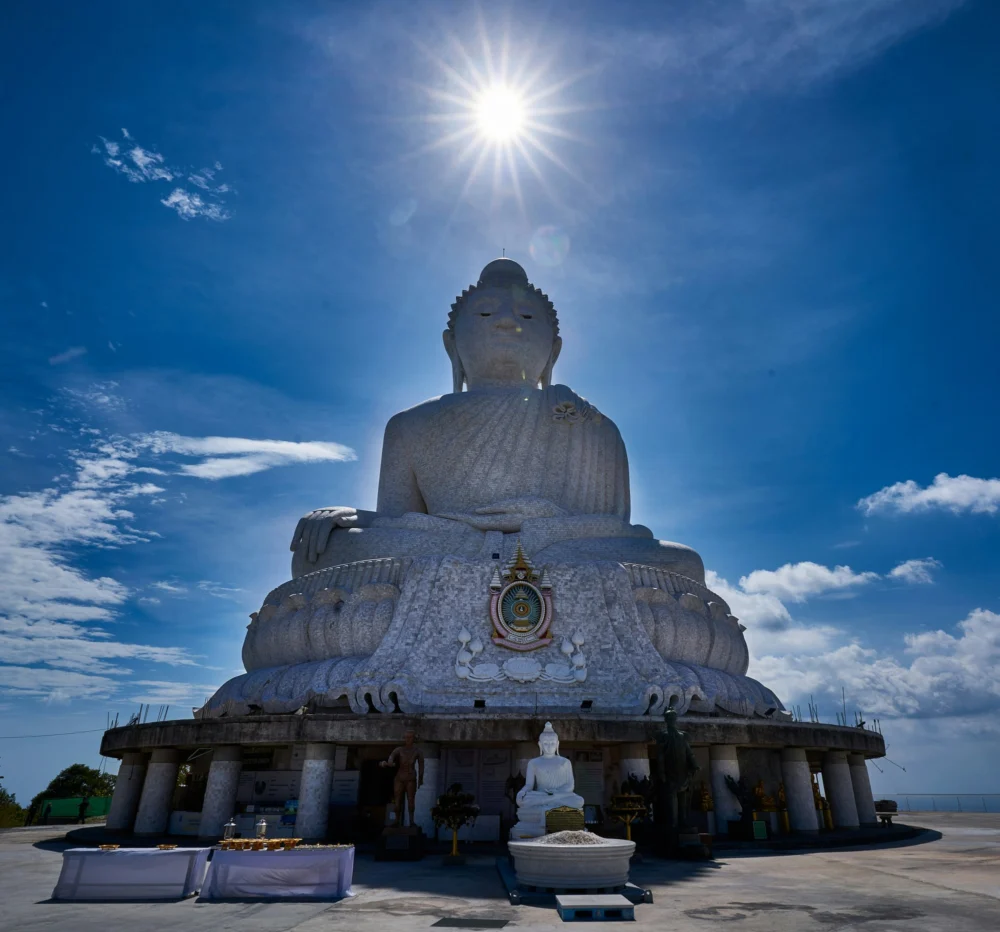
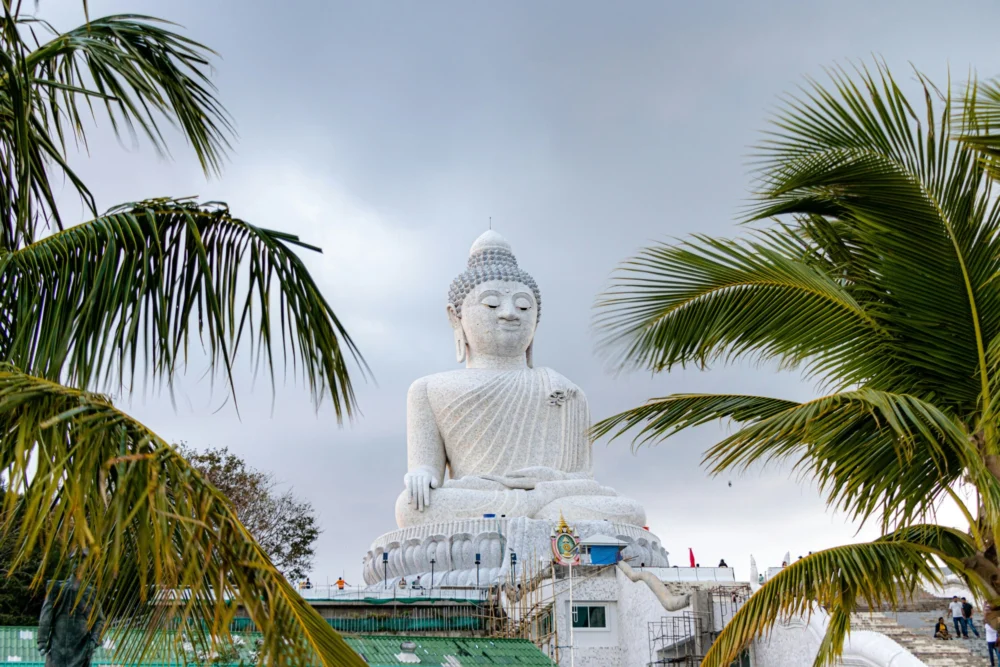
The main Buddha is approximately 45 metres high and 25.45 metres wide. It is constructed from reinforced concrete and covered with white marble, giving the surface its pale, luminous appearance.
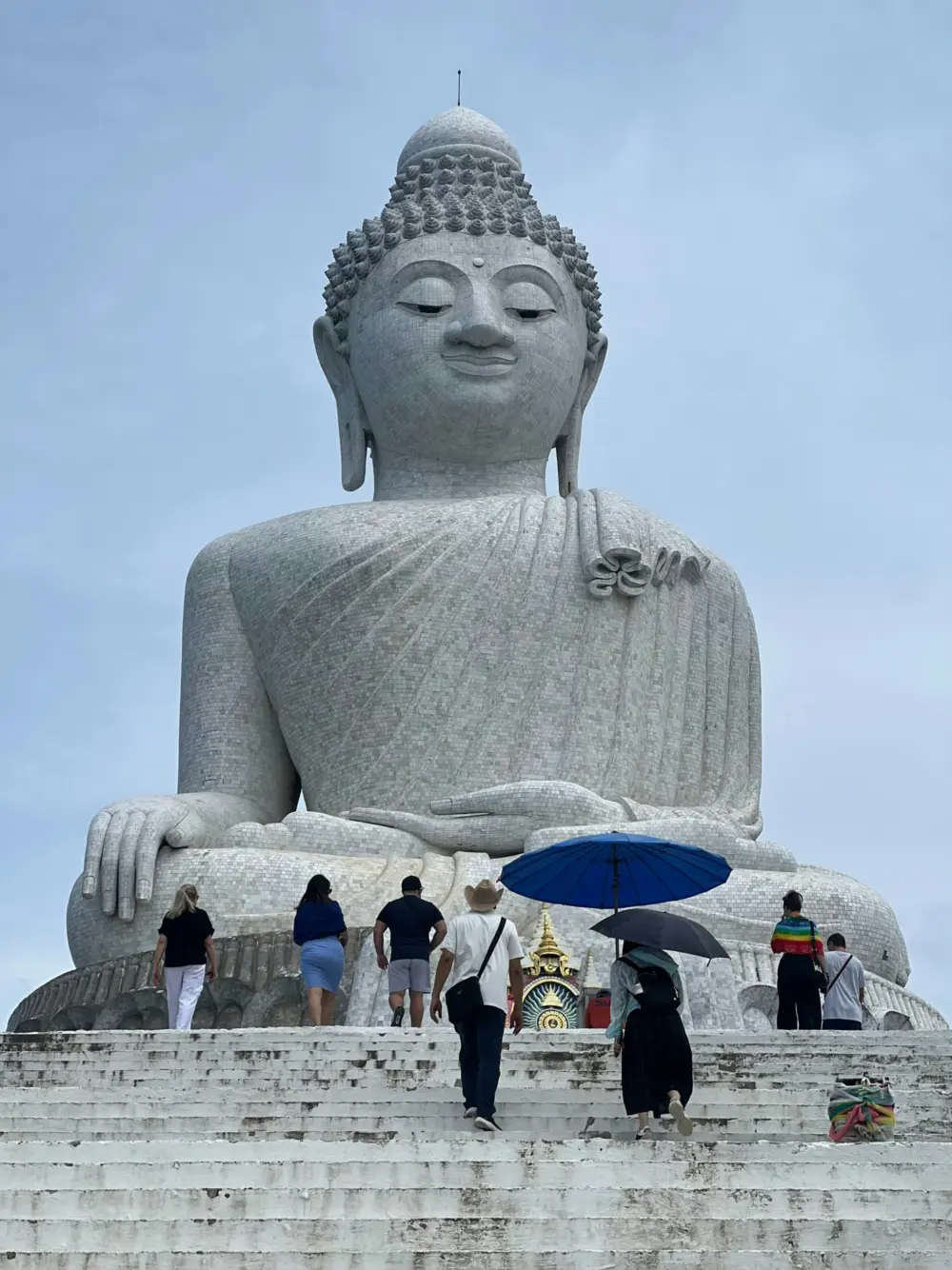
The image represents the Buddha in the Maravijaya, or victory-over-Mara, posture. The right hand reaches towards the earth while the left rests in the lap. In Buddhist tradition, this posture recalls the moment the Buddha called the earth to witness his enlightenment and overcame fear, temptation and doubt.
Its size is impressive, but its elevated setting creates the strongest visual effect. From below, the Buddha appears to rise above the forested ridge; from the upper terrace, the surrounding landscape becomes part of the experience.
What Is the Smaller Golden Buddha Beside the Main Statue?
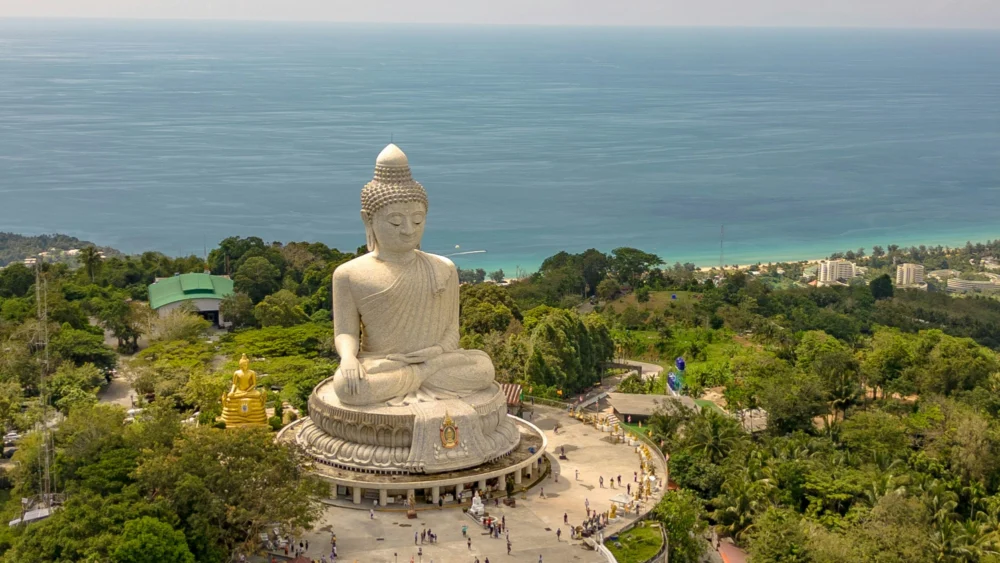
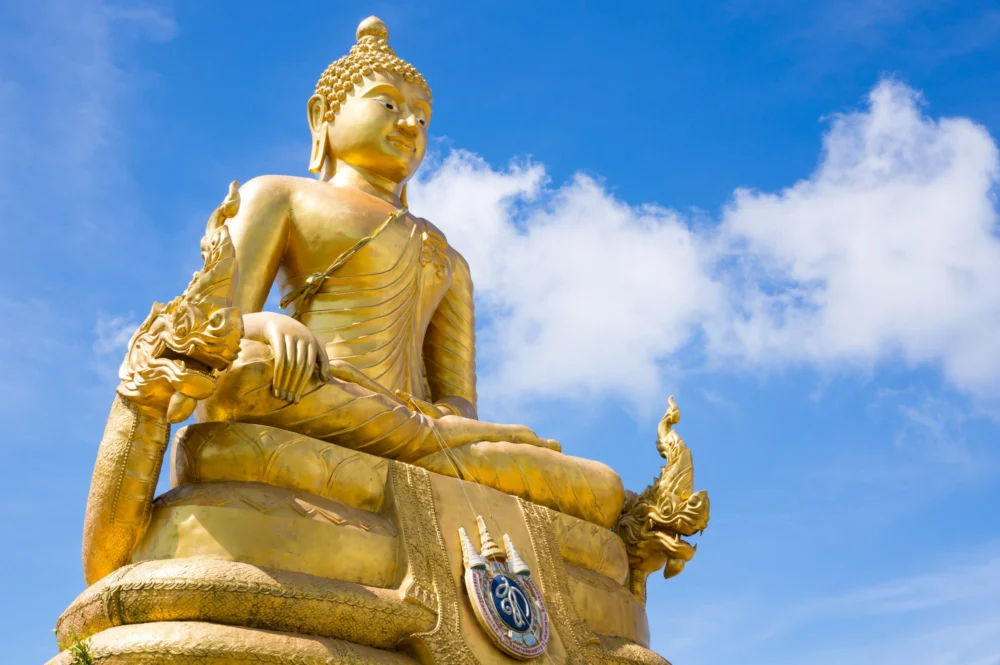
The white Buddha is not the only important image at the site. A smaller golden-coloured Buddha stands nearby and provides a striking contrast with the main marble landmark.
The golden image is approximately 12 metres high and was cast from brass. Many visitors walk directly towards the largest statue and overlook this second Buddha, but it is worth stopping to observe both images and their different materials.
What Other Highlights Can Visitors See?
Smaller Sacred Images
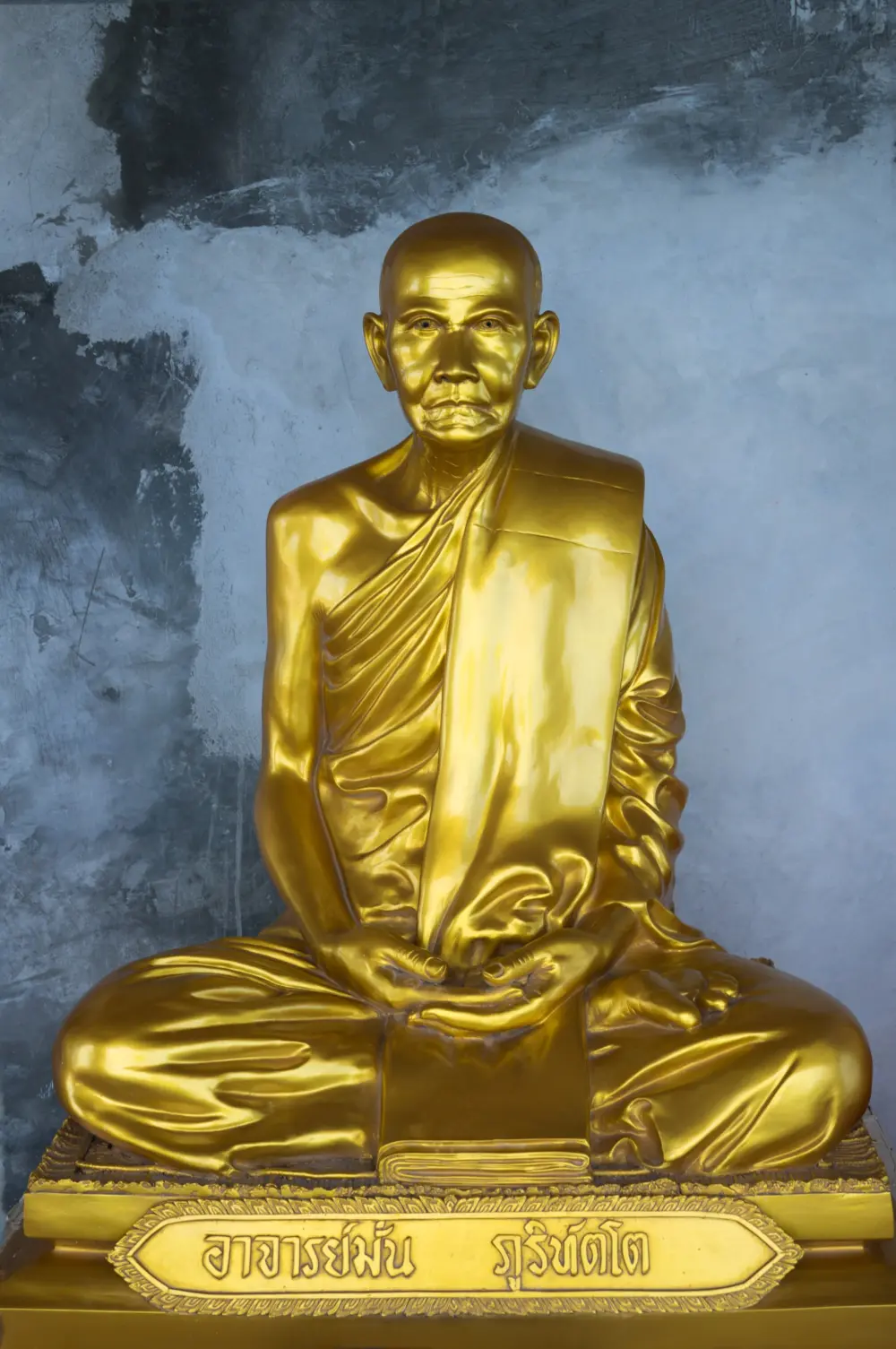
Several smaller Buddha images and religious statues can be found around the base and lower parts of the complex. These details remind visitors that Big Buddha is not simply a viewpoint or photo location.
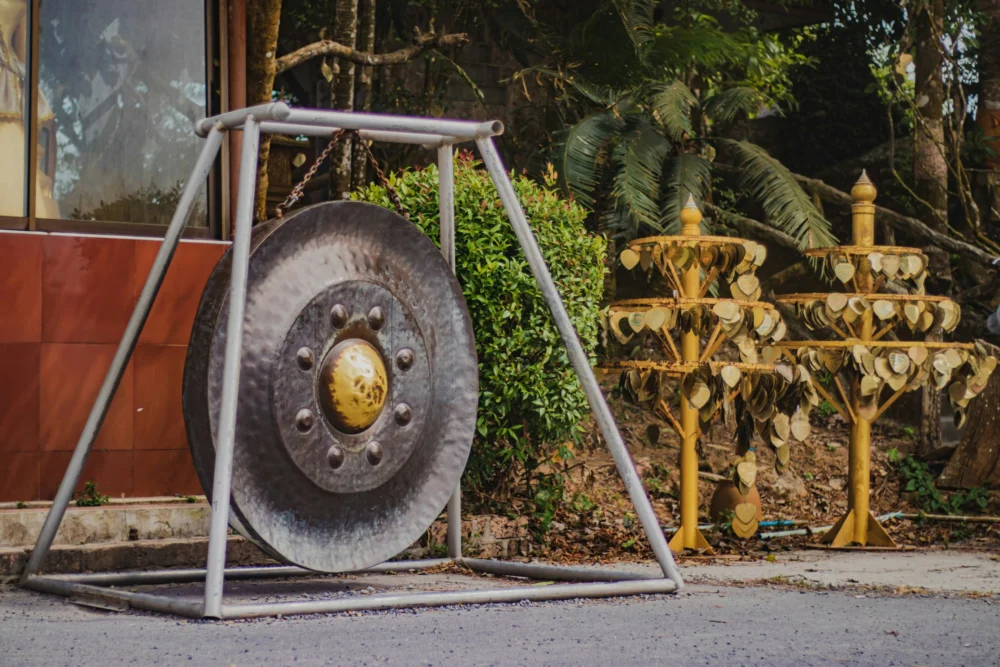
The “Lucky Person” Temple Gong
The large gong is one of the most interesting features at Big Buddha Phuket. Instead of striking it, visitors sometimes try to make it resonate by slowly rubbing the raised circular centre with the palm of their hand.
According to a popular local belief, a lucky person—or someone with particularly good fortune—will be able to make the gong produce a deep humming sound through friction alone. If the gong remains silent no matter how long someone rubs it, people may jokingly say that the person’s luck has not arrived yet.
Of course, producing the sound also depends on hand position, pressure and technique. It should therefore be understood as a playful local tradition rather than a genuine test of someone’s fortune. Visitors who try it should follow the site’s instructions and treat the religious object respectfully.
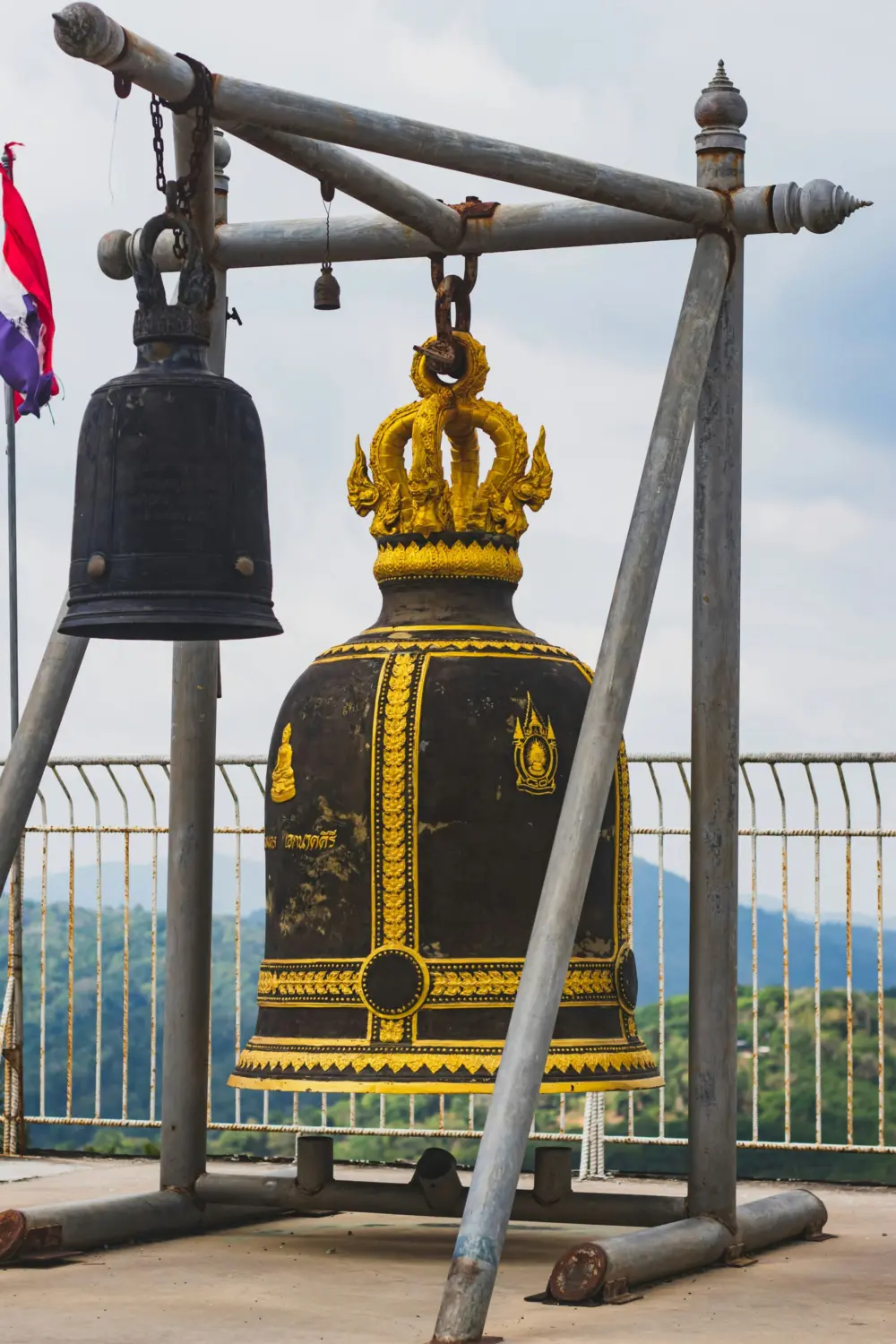
The Bronze Temple Bell
The complex also contains a large Thai temple bell, known as a rakhang. Temple bells traditionally help mark ceremonies, invite mindfulness and symbolically carry the sound of Buddhist teachings.
What Can You See from Nakkerd Hill?
The hilltop viewpoint is one of the strongest reasons to visit. On a clear day, visitors can look over Chalong Bay and the southeastern side of Phuket, while other terraces reveal parts of Kata, Karon and the green hills of the south.
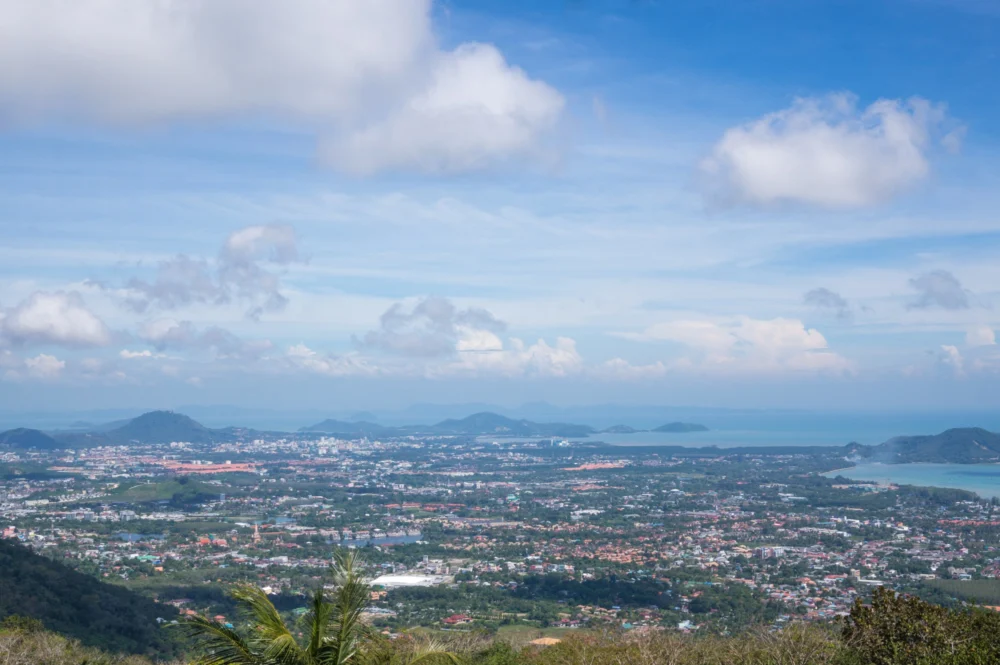
The scenery changes with the weather. Bright mornings offer clearer distant views, while late-afternoon light can give the marble a warmer colour. During the rainy season, clouds may hide the horizon, but the mist around the hills can create a quieter and more dramatic atmosphere.
When Is the Best Time to Visit?
Morning is generally cooler and may be more comfortable for walking around the terraces. Late afternoon often provides softer light for photographs, but visitors should arrive well before the last admission time.
Avoid rushing to the site shortly before closing. Allow approximately one hour to see the main Buddha, smaller religious images, temple features and viewpoints without turning the visit into a quick photo stop.
During heavy rain, reconsider travelling up the steep hill road and check whether visitor access has been restricted.
What Should You Wear?
Big Buddha is a religious site, so visitors should dress respectfully.
- Cover the shoulders and chest.
- Wear shorts, trousers or a skirt that reaches close to the knees.
- Avoid beachwear, transparent clothing and very short shorts.
- Speak quietly near prayer and monk areas.
- Do not climb on statues or sacred structures for photographs.
- Ask before photographing monks or people who are praying.
A light scarf or sarong can be useful, but arriving appropriately dressed is more respectful than depending on borrowed coverings.
How Do You Reach Big Buddha Phuket?
The main road approaches Nakkerd Hill from the Chalong side of southern Phuket. Travellers can visit by car, taxi, private driver or motorbike.
The uphill road has steep sections and curves. Drivers unfamiliar with Phuket’s hills—especially inexperienced motorbike riders—should travel slowly and avoid the route during heavy rain. A taxi or private driver is the safer option for visitors who are not confident on steep roads.
The upper statue platform includes stairs, although lower terraces still provide views for travellers who cannot comfortably complete the climb.
What Can You Combine with Big Buddha?
Big Buddha works well as part of a southern Phuket cultural and sightseeing day. Wat Chalong can be visited separately to understand a more traditional Phuket temple, while Kata, Karon, Rawai or Nai Harn can be added according to your route.
Travellers interested in Phuket’s architecture and multicultural history can continue with our Phuket Old Town walking guide.
For another landmark connected to local history, community life and an old Phuket love story, see our Sarasin Bridge guide.
International visitors preparing for their holiday may also want to review the Thailand entry requirements and arrival rules before departure.
Sea Me Again Perspective
Big Buddha is at its best when visitors slow down. The view may attract people to the hill, but the quieter details—the smaller statues, temple bell, gong, marble surface and people coming to pray—give the place its real character.
Treat it as a cultural and religious visit first and a photography location second. That approach usually creates a more meaningful Phuket experience.
Frequently Asked Questions
Is Big Buddha Phuket open in 2026?
Local reporting states that Big Buddha reopened on 3 March 2026 following its closure after the August 2024 landslide. Because access conditions can change, check a current local notice before travelling.
How tall is Big Buddha Phuket?
The main seated Buddha is approximately 45 metres high and 25.45 metres wide.
Is there an entrance fee?
Entry has traditionally been free, although visitors may see donation areas supporting the religious complex and its maintenance. Donations should be voluntary.
Is Big Buddha an ancient Phuket temple?
No. It is a modern Buddhist monument and religious complex developed from the early 2000s. Traditional temples such as Wat Chalong have a much longer local history.
What is special about the smaller golden Buddha?
It is a separate brass Buddha image standing beside the main white marble landmark. Its golden colour and smaller scale create a strong visual contrast with the main statue.
How long should I spend at Big Buddha?
Allow approximately one hour for the main statue, smaller sacred images, temple features and panoramic terraces.
Can children and older travellers visit?
Yes, but families should consider the heat, stairs and steep hill road. The lower terraces may be more manageable for visitors who have limited mobility.
What is the most important rule when visiting?
Dress modestly and remember that local people use the site for prayer and religious practice. Keep your voice low and behave respectfully around sacred images and monks.